

Why Do I Keep Getting Styes? Causes, Prevention, and Treatment
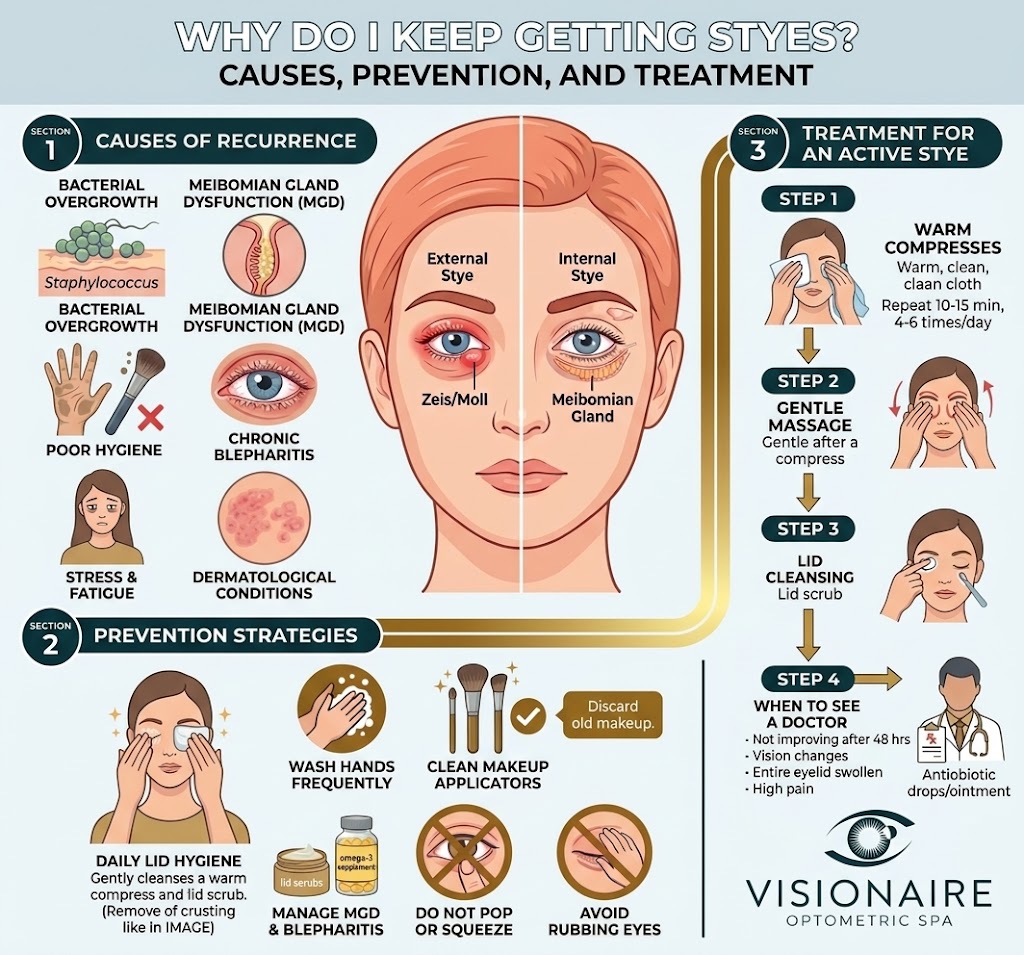
If you have ever had one stye disappear only to find another bump forming a few weeks or months later, you may have wondered:
“Why do I keep getting styes if I take care of my eyes?”
You are not alone.
People with recurring styes often describe the same frustrating cycle: a painful bump appears, they use warm compresses, it improves, and then another one comes back.
Recent patient discussions online reflect this frustration. Some people report dealing with recurrent styes for years despite regular eyelid hygiene and warm compresses. Others eventually discover that their recurring styes are associated with conditions such as Meibomian gland dysfunction (MGD) or blepharitis.
The important question may not be only how to get rid of the next stye, but why they keep coming back in the first place.
What Is a Stye?
A stye, also called a hordeolum, is a painful, red bump that develops on or near the edge of the eyelid.It can look similar to a small pimple and may cause:
- Eyelid swelling
- Tenderness or pain
- Redness
- Tearing
- A localized bump near the eyelashes
- Sometimes a small amount of discharge or pus
Styes are commonly associated with bacterial infection involving one or more small glands near the eyelashes. Internal styes can involve the Meibomian glands.
Most styes are temporary and resolve on their own.
But when they keep coming back, there may be another issue worth investigating.
Why Do I Keep Getting Styes?
Recurring styes can have several contributing factors.
1. Blocked or Dysfunctional Meibomian Glands
Your eyelids contain tiny oil-producing glands called Meibomian glands.These glands release oils that become part of your tear film and help prevent your tears from evaporating too quickly.
When these glands become blocked or their oil becomes abnormal, the glands may not function properly.
This is known as Meibomian gland dysfunction (MGD).
MGD can be associated with recurring styes and chalazia, as well as dry, burning, irritated, or watery eyes.
Think of these glands like tiny oil channels.
If the oil becomes thick or the opening becomes blocked, the normal flow is disrupted.
That can create the conditions for inflammation and recurring eyelid problems.
2. Blepharitis
Blepharitis is inflammation along the eyelid margins.It can cause:
- Red or swollen eyelids
- Crusting around the eyelashes
- Burning or irritation
- Itching
- Flaking
- Recurrent styes or chalazia
Chronic eyelid inflammation is a recognized risk factor for developing styes.
If the underlying eyelid inflammation is not addressed, simply treating each individual stye may not prevent another one from appearing.
3. Rosacea and Ocular Rosacea
There is also a connection between recurrent eyelid problems and rosacea.People with facial or ocular rosacea may have inflammation affecting the eyelids and Meibomian glands.
Rosacea is recognized as a risk factor for styes and chalazia.
This is one reason recurrent styes shouldn't always be viewed as isolated infections.
Sometimes they are part of a larger pattern involving eyelid inflammation and gland dysfunction.
Does Getting Styes Mean My Eyes Are Dirty?
Not necessarily.This is an important distinction.
Poor hand hygiene, touching the eyes, contaminated cosmetics, and improper contact-lens handling can increase the risk of eye infections.
But someone can have excellent hygiene and still experience recurrent styes.
Patients themselves often ask this question because they are frustrated that they continue having styes despite washing their face, cleaning their eyelids, and using warm compresses regularly.
If the problem keeps returning despite good hygiene, it may be time to look beyond hygiene alone.
Stye vs. Chalazion: Are They the Same?
Not exactly.The two are often confused because they can both appear as bumps on the eyelid.
A Stye
A stye is generally associated with an acute infection or inflammation involving an eyelid gland and is often red and painful.
A Chalazion
A chalazion is usually caused by a blocked Meibomian gland followed by inflammation. It often produces a firmer bump and may be less painful than an active stye.
The distinction matters because a patient who thinks they are repeatedly getting "styes" may actually be experiencing recurrent chalazia or underlying Meibomian gland dysfunction.
Why Do Warm Compresses Help?
Warm compresses are one of the most common home-care recommendations for styes.
Heat can help loosen gland secretions and encourage drainage. Warm compresses may also help a stye resolve more quickly.
For a typical stye, Mayo Clinic recommends a warm washcloth over the closed eye for about 5–10 minutes several times a day, followed by gentle eyelid massage.
But there is an important point:
If you keep getting styes despite doing warm compresses, the answer may not simply be “do more warm compresses.”
The underlying cause may need to be evaluated.
What If Warm Compresses Aren't Enough?
This is one of the biggest frustrations expressed by patients with recurrent styes.Some people report using warm compresses every day, cleaning their eyelids, and maintaining good hygiene but continuing to develop new styes.
That can happen because the recurring problem may involve more than the individual stye.
For example, there may be:
Meibomian gland dysfunction
Chronic blepharitis
Eyelid inflammation
Rosacea
Blocked glands
Abnormal oil secretion
Other ocular-surface problems
In those situations, the goal becomes understanding what is causing the repeated blockage or inflammation, rather than simply waiting for each new bump to appear.
What Can You Do to Prevent Styes?
There are several habits that may help reduce the risk of recurring eyelid problems.
Keep your eyelids clean
Gentle eyelid hygiene can help remove debris and buildup around the eyelashes.
Don't sleep with eye makeup
Remove eye makeup before going to bed and replace old or expired cosmetics.
Practice good contact-lens hygiene
Always wash your hands before handling contact lenses and follow appropriate cleaning and replacement instructions.
Avoid squeezing or popping a stye
Trying to pop a stye can spread infection and potentially make the problem worse.
Pay attention to recurring patterns
If styes continue appearing, particularly in the same eye or repeatedly along the eyelid, don't just treat each episode separately.
That pattern itself is useful information.
When Is a Recurring Stye a Sign You Should Get Evaluated?
An occasional stye is usually not a reason for concern.But an evaluation may be appropriate if:
You repeatedly develop styes
Styes occur several times a year
You constantly have eyelid inflammation
You also experience dry or burning eyes
Your eyelids are frequently crusty or irritated
You have recurring chalazia
Warm compresses provide only temporary improvement
A bump doesn't go away
The redness or swelling spreads beyond the eyelid
Mayo Clinic recommends seeking professional care when a stye does not begin improving after about 48 hours or when redness and swelling spread across the eyelid or into the face.
Persistent or atypical eyelid lesions also deserve professional evaluation because other conditions can sometimes resemble a chalazion or stye.
What Does a Recurrent Stye Have to Do With Dry Eye?
This connection is easy to miss.The same Meibomian glands that can become involved in recurrent styes are also important for maintaining a healthy tear film.
When these glands are not functioning properly, patients may experience:
Dryness
Burning
Redness
Watery eyes
Fluctuating vision
Foreign-body sensation
Contact-lens discomfort
Recurrent styes or chalazia MGD is a common cause of dry-eye symptoms and can be associated with recurring styes and chalazia.
So if you are experiencing both recurrent styes and chronic dry-eye symptoms, it may be worth evaluating the health and function of your Meibomian glands.
How Can Visionaire Help With Recurrent Styes?
At Visionaire Optometry Spa in Riverside, the goal is not simply to treat the bump you see today.The more important question is:
Why does this keep happening?
A comprehensive evaluation can look at the overall condition of the eyelids, Meibomian glands, tear film, and ocular surface to identify factors that may be contributing to recurrent eyelid problems.
This helps create a more personalized approach rather than treating every patient exactly the same way.
The Visionaire approach:
Evaluate → Identify the Cause → Personalize Treatment → Follow Up
Depending on the findings, professional dry-eye and eyelid treatments may be considered as part of a personalized treatment plan.
Visionaire offers advanced services including Lumecca-I IPL, Forma-I radiofrequency, and professional eyelid treatments for appropriate patients.
The important point is that not every patient with a stye needs the same treatment.
The treatment should be based on what is actually happening with the eyelids and glands.
Can Professional Treatments Help With Recurrent Styes?
If recurring styes are associated with Meibomian gland dysfunction, blepharitis, or ocular-surface inflammation, addressing those underlying conditions may become an important part of long-term management.
Professional treatments can be considered when appropriate after evaluation.
At Visionaire, the focus is not simply:
“How do we get rid of this stye?”
It is:
“Why is this happening repeatedly, and what can we do to improve the health of the eyelids and ocular surface?”
That difference matters.
The Bottom Line: Your Stye May Be a Symptom, Not the Whole Problem
If you keep getting styes, you're not necessarily doing something wrong.
Sometimes recurrent styes are connected to underlying eyelid conditions such as Meibomian gland dysfunction, blepharitis, or rosacea.
Warm compresses and good eyelid hygiene can be useful, but when the problem keeps returning, it may be time to look deeper.
At Visionaire Optometry Spa in Riverside, a personalized evaluation can help determine whether your recurring styes may be connected to gland dysfunction, eyelid inflammation, dry eye, or another condition.
Don't just keep treating the next stye. Find out why it keeps coming back.
Frequently Asked Questions
Why do I keep getting styes?
Recurring styes can be associated with eyelid inflammation, blepharitis, Meibomian gland dysfunction, rosacea, or other factors. Hygiene and cosmetic/contact-lens practices can also affect risk.
Are recurring styes caused by poor hygiene?
Not necessarily. Hygiene can influence the risk of eyelid infections, but recurrent styes can also occur because of underlying gland dysfunction or eyelid inflammation.
Can MGD cause styes?
Yes. Meibomian gland dysfunction can be associated with recurring styes and chalazia.
How long should a stye last?
Many styes resolve on their own. Warm compresses may help speed drainage and healing. A stye that does not begin improving after about 48 hours, or one associated with spreading redness or swelling, should be evaluated.
Can I pop a stye?
No. Squeezing or popping a stye can spread infection.
Can IPL help recurrent styes?
IPL may be considered in certain patients when recurrent eyelid problems are associated with conditions such as Meibomian gland dysfunction or ocular-surface inflammation. It is not a universal treatment for every stye, so an appropriate evaluation should come first.
Ready to Find Out Why Your Styes Keep Coming Back?
If you're tired of treating one stye after another, it may be time to look beyond the individual bump.A comprehensive evaluation at Visionaire Optometry Spa in Riverside can help assess your eyelids, Meibomian glands, tear film, and ocular surface to better understand what may be contributing to your recurring symptoms.
Visionaire Optometry Spa
18876 Van Buren Blvd, Suite 203
Riverside, CA 92508
951-498-3937
Your next stye may be temporary. The reason you keep getting them may deserve a closer look.

All Eye
Care Services

Keep
In Touch


Our Services

Hours of Operation
- Monday 9:00 AM - 5:00 PM
- Tuesday 9:00 AM - 1:00 PM
- Wednesday 10:00 AM - 6:00 PM
- Thursday 9:00 AM - 5:00 PM
- Friday 9:00 AM - 1:00 PM
- Saturday Limited Availability
(Deposit required for Saturday Appointments Applied towards services or materials)
- Sunday Closed
© 2026 Visionaire Optometry Spa. All rights Reserved. Accessibility Statement - Privacy Policy - Sitemap
Powered by:

