

Can Menopause Cause Dry Eyes? Understanding Hormones, Dry Eye, and What You Can Do
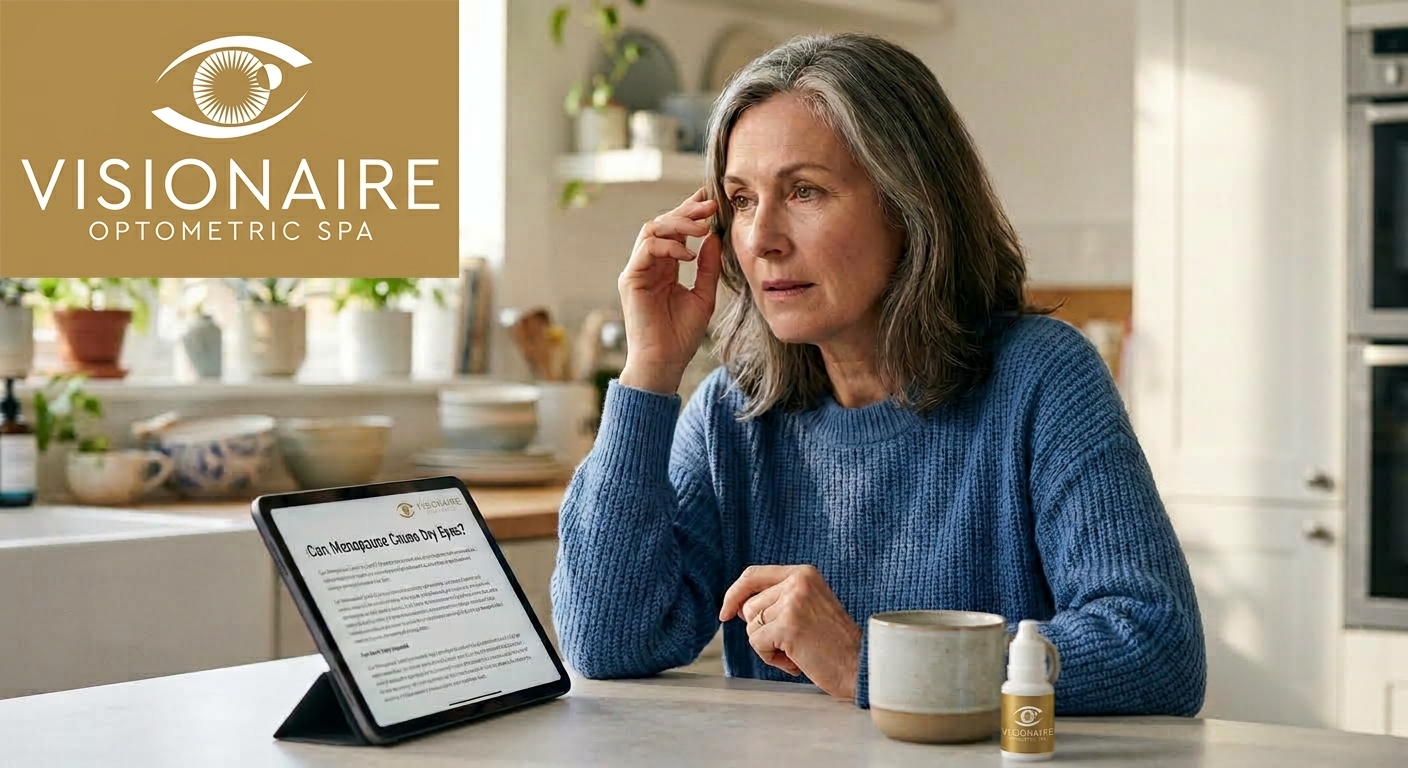
If your eyes suddenly feel dry, gritty, burning, irritated, or blurry, you may be wondering if menopause could have something to do with it.
The answer is yes, menopause can contribute to dry-eye symptoms.
For some women, changes in their eyes become noticeable during perimenopause or menopause, even if they never had significant dry-eye problems before. Research has found that hormonal changes can affect the tear film, ocular surface, and Meibomian glands that help keep the eyes properly lubricated.
And for many women, the frustrating part is that the problem can feel like it appeared out of nowhere.
You may think:
“Why are my eyes suddenly so dry?”
“Why do my contact lenses suddenly bother me?”
“Why do artificial tears only help for a few minutes?”
“Is this just another symptom of menopause?”
In many cases, the answer is more complicated than simply needing more eye drops
How Can Menopause Affect Your Eyes?
Your eyes depend on a healthy tear film to remain comfortable and maintain clear vision.That tear film contains several components, including:
- Water
- Oil
- Mucins and other components that help the tears spread and remain stable
Hormones such as estrogen and androgens influence the ocular surface and components of the tear film. During menopause, hormonal changes can alter this balance and contribute to dry-eye symptoms.
Recent research has also found that postmenopausal women may experience more tear-film instability and Meibomian gland dysfunction compared with younger women and age-matched men.
So menopause isn't simply about producing "fewer tears."
The quality and stability of your tears can also matter.
What Does Menopause-Related Dry Eye Feel Like?
Dry eye doesn't always feel like your eyes are simply "dry."You may experience:
- Burning or stinging
- A gritty or sandy sensation
- Redness
- Watery eyes
- Blurred or fluctuating vision
- Light sensitivity
- Eye fatigue
- Difficulty wearing contact lenses
- A feeling that something is stuck in your eye
- Symptoms that become worse later in the day
The American Academy of Ophthalmology lists burning, blurred vision, gritty sensations, redness, irritation, excessive tearing, and contact-lens discomfort among common dry-eye symptoms.
Some women describe the experience as if their eyes suddenly became much more sensitive than they used to be.
That experience is real.
But it doesn't necessarily mean menopause is the only cause.
Why Are My Eyes Dry During Menopause Even If I Drink Plenty of Water?
This is an important question.Staying hydrated is good for your overall health, but dry eye isn't simply a matter of not drinking enough water.
Your tears need to have the right balance and remain on the surface of your eyes long enough to protect them.
One important part of that system is the Meibomian glands.
These tiny glands inside your eyelids produce oils that form part of the outer layer of the tear film. That oil helps slow evaporation.
If the glands become blocked or dysfunctional, your tears may evaporate too quickly.
This is known as Meibomian gland dysfunction (MGD).
Hormonal changes associated with menopause may be one of the factors influencing the ocular surface and Meibomian glands.
Could Menopause Be Causing My Meibomian Gland Dysfunction?
It can be part of the picture.A recent study comparing postmenopausal women with age-matched men and younger women found more pronounced Meibomian gland dysfunction and a more evaporative pattern of dry eye among the postmenopausal group.
This is important because it helps explain why simply adding artificial tears doesn't always solve the problem.
Imagine your tears as water inside a container.
If there isn't enough oil on top, the water evaporates more quickly.
Similarly, if your Meibomian glands aren't producing healthy oils, your tears may become unstable and evaporate faster.
That's why a patient may use eye drops and feel better temporarily—but then experience dryness again shortly afterward
Why Do My Eye Drops Only Help for a Few Minutes?
This is one of the most frustrating experiences reported by women dealing with menopause-related dry eye.Some patients describe using artificial tears repeatedly throughout the day while still experiencing burning, grittiness, or blurry vision. Patient discussions in menopause and dry-eye communities frequently describe this pattern.
Artificial tears can provide valuable temporary lubrication.
But they don't necessarily correct every underlying factor contributing to dry eye.
If your symptoms are related to:
- Meibomian gland dysfunction
- Eyelid inflammation
- Tear-film instability
- Ocular-surface inflammation
- Hormonal changes
- Environmental factors
- Medications
- Contact-lens use
then simply adding more moisture may not address the entire problem.
The question becomes: Why are your eyes becoming dry in the first place?
Can Menopause Make Contact Lenses Uncomfortable?
Yes.Hormonal changes and dry-eye disease can make contact lenses more difficult to tolerate.
Some women who have worn contacts comfortably for years may suddenly notice:
- Burning
- Dryness
- Blurred vision
- A foreign-body sensation
- Increased need to remove their lenses
- Difficulty wearing contacts for an entire workday
Patient discussions also describe women who could previously wear contact lenses without significant problems but found them increasingly uncomfortable during perimenopause.
If contact lenses suddenly become uncomfortable around the same time that other menopause symptoms appear, an ocular-surface evaluation may be worthwhile.
Is It Just Menopause, or Is Something Else Going On?
This is where things become important.Menopause can contribute to dry eye, but not every case of dry eye during menopause is caused by hormones.
Other factors can include:
- Meibomian gland dysfunction
- Blepharitis
- Ocular rosacea
- Allergies
- Contact lenses
- Screen use
- Dry or windy environments
- Certain medications
- Thyroid disease
- Autoimmune conditions
- Previous eye surgery
The National Institutes of Health notes that hormonal changes during menopause can make dry eye more likely, while also identifying several other possible contributors.
That's why simply assuming, “It's menopause, so I just have to live with it,” may not be the best approach.
Can Hormone Replacement Therapy Fix Dry Eye?
This is an area where the answer is not straightforward.Research on hormone therapy and dry eye has produced mixed findings. Some studies have reported improvements in certain measures, while others have found no significant improvement in tear-film stability or comfort.
Because hormone therapy has broader health considerations, decisions about HRT should be made with your physician or qualified healthcare provider.
Your eye doctor can evaluate and manage the ocular symptoms separately rather than assuming that changing hormone therapy is the solution.
Do not start, stop, or change hormone therapy specifically for dry-eye symptoms without discussing it with your healthcare provider.
What Can You Do for Menopause-Related Dry Eye?
There are several approaches that may help, depending on what's causing your symptoms.At-home strategies may include:
- Using lubricating eye drops as recommended
- Taking breaks during prolonged screen use
- Blinking more consciously while using digital devices
- Avoiding direct airflow from fans or air conditioning
- Using appropriate eyelid hygiene
- Using warm compresses when appropriate
- Taking care of contact lenses according to professional recommendations
However, these strategies don't work the same way for everyone.
For example, warm compresses can be helpful for certain Meibomian gland problems, but the appropriate approach depends on the condition of your eyelids and ocular surface.
What If Home Remedies Aren't Enough?
This is where a professional dry-eye evaluation can make a difference.Instead of asking only:
“How dry are my eyes?”
a comprehensive evaluation should ask:
“Why are my eyes becoming dry?”
At Visionaire Optometry Spa, the evaluation can include factors such as:
- Meibomian gland function and structure
- Tear-film stability
- Eyelid health
- Ocular-surface condition
- Signs of inflammation
- Screen use and environmental factors
- Medications and relevant health history
- Hormonal changes that may be contributing
Visionaire's own dry-eye approach emphasizes identifying the underlying factors rather than giving every patient the same treatment.
How Can Visionaire Help With Menopause-Related Dry Eye?
At Visionaire Optometry Spa in Riverside, the goal is not simply to provide temporary moisture.The first step is understanding what is happening with your tear film, eyelids, and Meibomian glands.
Depending on the findings, treatment may include conservative home care, professional eyelid treatments, or advanced in-office therapies.
Visionaire offers treatments including:
Lumecca-I IPL
Lumecca-I is used at Visionaire as part of treatment for conditions associated with dry eye, including Meibomian gland dysfunction and ocular rosacea.
Forma-I Radiofrequency
Forma-I uses radiofrequency energy around the eye area and is designed to support Meibomian gland function and the oily layer of the tear film.
Professional Eyelid Treatments
Visionaire also offers professional eyelid treatments designed to address eyelid debris and conditions such as blepharitis that can contribute to ocular-surface problems.
Not every patient needs every treatment.
The important part is determining which factors are contributing to your symptoms first.
The Visionaire Approach
For menopause-related dry eye, the goal isn't to blame everything on hormones.Instead:
Evaluate → Identify the Cause → Personalize Treatment → Follow Up
Menopause may be one factor.
Meibomian gland dysfunction may be another.
Inflammation, medications, contact lenses, screen use, or environmental exposure may contribute as well.
Understanding the complete picture allows your treatment plan to be more specific to your eyes.
When Should You Get Your Dry Eyes Evaluated?
Consider scheduling an eye evaluation if you experience:
- Persistent dryness
- Burning or stinging
- Recurrent redness
- Blurry or fluctuating vision
- Increasing contact-lens discomfort
- Frequent use of artificial tears
- Gritty or sandy eyes
- Symptoms that interfere with reading or computer work
- Dry-eye symptoms that appeared or worsened during perimenopause or menopause
You don't have to wait until the symptoms become severe.
Frequently Asked Questions
Can menopause cause dry eyes?
Yes. Hormonal changes during menopause can contribute to dry-eye disease and ocular-surface changes.
Why did my dry eyes start during menopause?
Menopause involves significant hormonal changes that can affect the tear film, ocular surface, and Meibomian glands. However, other factors may also contribute.
Can menopause cause blurry vision?
Dry eye associated with hormonal changes can cause fluctuating or intermittent blurry vision because an unstable tear film can temporarily affect the optical surface of the eye.
Will dry eye go away after menopause?
Not necessarily. Dry eye can be a chronic, multifactorial condition. Symptoms may change over time, but persistent symptoms deserve evaluation rather than assuming they will automatically disappear.
Can IPL help menopause-related dry eye?
IPL may be considered when the patient's dry eye is associated with conditions such as Meibomian gland dysfunction or ocular-surface inflammation. It is not a treatment for menopause itself, and whether it is appropriate depends on the individual evaluation.
Should I stop hormone therapy if my eyes are dry?
No. Do not change or stop hormone therapy because of dry-eye symptoms without discussing it with your healthcare provider. Research on the relationship between HRT and dry eye is mixed.
Your Hormones May Be Changing. Your Eye Care Can Change Too.
If your eyes became noticeably drier during perimenopause or menopause, you're not imagining the connection.
Hormonal changes can influence the tear film and ocular surface, and some women may also develop Meibomian gland dysfunction or other eyelid problems during this stage of life.
But you don't have to assume that uncomfortable, burning, gritty eyes are simply something you have to accept.
At Visionaire Optometry Spa in Riverside, the goal is to determine what is contributing to your symptoms and create a personalized approach based on your eyes.
The first step isn't simply adding another bottle of eye drops.
It's finding out why your eyes are dry.
Visionaire Optometry Spa
18876 Van Buren Blvd, Suite 203
Riverside, CA 92508 951-498-393

All Eye
Care Services

Keep
In Touch


Our Services
Hours of Operation
- Monday 9:00 AM - 5:00 PM
- Tuesday 9:00 AM - 1:00 PM
- Wednesday 10:00 AM - 6:00 PM
- Thursday 9:00 AM - 5:00 PM
- Friday 9:00 AM - 1:00 PM
- Saturday Limited Availability
(Deposit required for Saturday Appointments Applied towards services or materials)
- Sunday Closed
© 2026 Visionaire Optometry Spa. All rights Reserved. Accessibility Statement - Privacy Policy - Sitemap
Powered by:

