


Can an Optometrist Actually Help My Dry Eyes?
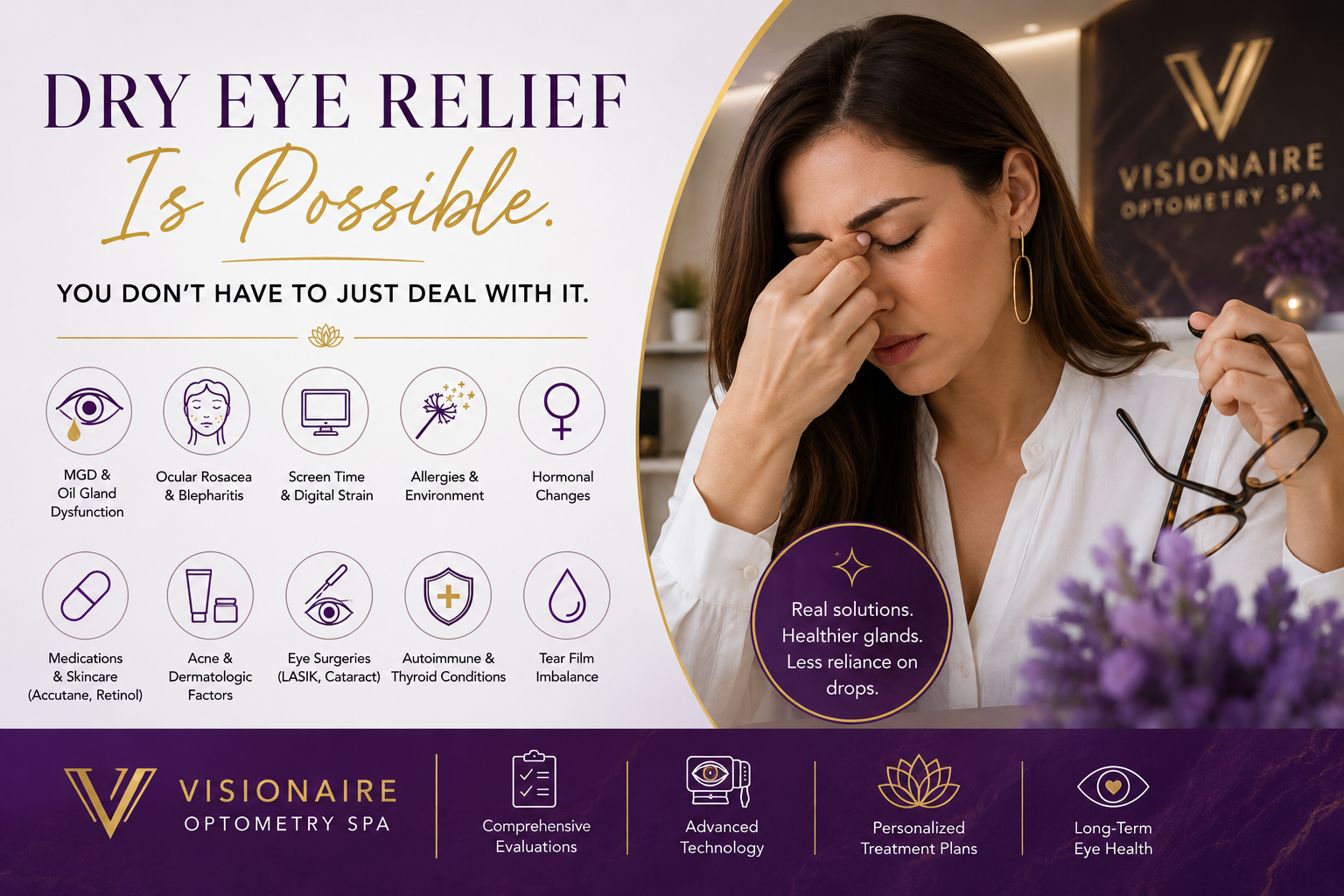
If you’ve been using artificial tears for years, constantly rubbing your eyes, dealing with red or irritated eyelids, or experiencing blurry vision by the end of the day, you may be wondering:
Can an optometrist actually help my dry eyes?
Yes—but there’s an important distinction.
Not every optometrist specializes in dry eye disease.
A dry-eye-focused optometrist may have specialized diagnostic tools, training, and treatment options to determine why your eyes are struggling and create a personalized plan to manage the underlying factors.
At Visionaire Optometry Spa, we don’t believe every patient should receive the same dry-eye treatment.
We look at the whole person.
Dry Eye Is a Blanket Term
One of the biggest things I want patients to understand is that “dry eye” isn’t necessarily one disease with one cause.
Think of it like the word “allergies.” Someone can have seasonal allergies, environmental allergies, or other allergic conditions with very different triggers.
Dry eye is similar.
Two people can both say, “I have dry eyes,” while having completely different underlying factors.
Dry eye can be associated with:
Meibomian gland dysfunction (MGD)
Ocular rosacea and blepharitis
Allergies and chronic eye rubbing
Hormonal changes, including perimenopause and menopause
Prolonged computer use
Dust, dander, and environmental exposure
Certain medications
Dermatologic conditions and acne treatments
Previous LASIK or cataract surgery
Systemic and autoimmune conditions
The National Eye Institute’s overview of dry eye also recognizes medications, thyroid and autoimmune conditions, laser eye surgery, environmental factors, and prolonged screen use as potential contributors. (National Eye Institute)
Conditions such as rheumatoid arthritis, lupus, Sjögren syndrome, and thyroid disorders can also be associated with dry-eye disease.
That’s why your medical history, medications, hormones, skincare routine, lifestyle, and previous eye surgeries can all matter.
Finding the “Why” Behind Your Dry Eye
During an eye examination, we evaluate the health of your eyes. If I see signs of Meibomian gland dysfunction or other concerns, I may recommend a dedicated medical dry-eye evaluation.
Depending on the patient, we assess:
Meibomian gland function and structure
Gland loss through meibography
Tear breakup time
Inflammation
Eyelids and cornea
Computer and screen use
Allergies and environment
Hormonal and systemic health factors
Medications and skincare products
Meibomian glands produce oils that form the outer layer of the tear film and help slow evaporation. When these glands become blocked or dysfunctional, tear-film stability can be affected. The American Academy of Ophthalmology’s EyeWiki provides a detailed overview of MGD and the role of gland dysfunction in ocular-surface disease. (EyeWiki)
The goal isn’t simply to ask, “How can we make your eyes feel less dry?”
It’s:
“Why are your eyes becoming dry in the first place?”
Why Artificial Tears Aren’t Always Enough
Artificial tears can absolutely be helpful.
But if the Meibomian glands are blocked or functioning poorly, adding more moisture doesn’t necessarily address the underlying problem.
I sometimes describe Meibomian gland expression to patients as an “oil change.”
We’re working to improve the flow of the oils that help stabilize the tear film.
Depending on what we find, treatment may include therapies such as IPL/Lumecca-i, Forma-i, Meibomian gland expression, ZEST eyelid cleansing, and other ocular-surface treatments.
Not every patient needs every treatment.
The treatment plan should be based on what we find during the evaluation.
Your Skin, Medications, and Previous Surgeries Matter Too
Dry eye isn’t always caused by something happening directly inside your eye.
For example, isotretinoin (Accutane), a medication commonly used for acne, has been associated with changes in Meibomian gland morphology and dry-eye testing. (PubMed)
That’s why I ask patients about their skincare routine and medications—including retinoids or products being used around the eyes.
Previous eye surgery can also be relevant. Dry-eye symptoms can occur after procedures such as LASIK and cataract surgery, and a patient’s surgical history is important when evaluating persistent ocular-surface symptoms. Research has specifically examined dry eye following cataract surgery. (National Eye Institute)
This doesn’t mean every person who takes Accutane or has LASIK or cataract surgery will develop chronic dry eye.
It means those factors belong in the conversation.
A Patient Who Had Been Itching Her Eyes for More Than a Decade
One patient I’ll never forget had been dealing with itchy eyes for more than 10 years.
She had tried artificial tears but wasn’t getting meaningful relief.
During her evaluation, we discovered poor-functioning Meibomian glands. She also spent about eight hours a day on a computer and experienced allergies at times.
Chronic inflammation, screen use, allergies, and mechanical eye rubbing were all contributing factors.
We created a guided treatment plan for her.
Within her first few treatment sessions, she began noticing a difference.
She wasn’t constantly itching her eyes anymore.
Her vision improved.
She felt better.
And her family noticed.
Her husband actually shook my hand and said, laughing:
“Thank you. I don’t know what you did with her, but that investment in her eyes really worked!”
That’s what makes this work so rewarding.
It’s not just about a test result. It’s about helping someone function and feel better in their everyday life.
Who Should Consider a Dry-Eye Evaluation?
A specialized evaluation may be worthwhile if you:
Have had dry-eye symptoms for years
Constantly need artificial tears
Have blurry or fluctuating vision after computer use
Have chronically red eyes or eyelids
Frequently rub your eyes
Experience chronic itching
Have recurring styes
Have rosacea
Struggle with contact lenses
Are experiencing hormonal changes
Work in a dusty or dander-filled environment
You don’t have to wait until your symptoms become severe.
Prevention Matters
One of the biggest lessons I’ve learned is that prevention matters.
When I see Meibomian gland loss, I don’t want to wait until more gland function is lost before addressing the problem.
My philosophy is simple:
I want to recommend what I genuinely believe is best for the patient.
That doesn’t mean everyone needs the most expensive treatment.
It means patients deserve to understand their options and why I’m recommending a particular approach.
If we can identify problems earlier and address factors that may be contributing to gland dysfunction, we may have a better opportunity to preserve the function that remains.
What Does Success Look Like?
Success isn’t necessarily never using another eye drop.
For many patients, success looks like:
Sitting at a computer longer
Reaching for drops less often
Rubbing their eyes less
Having fewer styes
Less eyelid inflammation
Wearing contact lenses more comfortably
Less fluctuating vision
Dry eye is often something we manage, rather than something we permanently “cure.”
Once patients reach a manageable state, we may see them every 4–6 months to monitor their ocular surface and gland function and help maintain their progress.
I often compare it to managing diabetes.
There may be treatment, lifestyle changes, monitoring, and maintenance. The plan can change as the patient’s condition changes.
Frequently Asked Questions
Can dry eye damage your eyes?
Chronic dry eye can affect the ocular surface and contribute to irritation, inflammation, and fluctuating vision. Persistent symptoms shouldn’t simply be ignored. (National Eye Institute)
Can Meibomian gland loss grow back?
When gland loss is present, our focus is generally on protecting the functioning glands that remain and addressing factors contributing to further dysfunction.
That is one reason I believe early evaluation and prevention are important.
Can Accutane cause dry eyes?
Isotretinoin (Accutane) can be associated with changes in the Meibomian glands and tear film. If you’ve taken or are taking isotretinoin and experience persistent dry-eye symptoms, tell your eye doctor. (PubMed)
Can LASIK or cataract surgery cause dry eyes?
Dry-eye symptoms can occur after eye surgery, including LASIK and cataract surgery. If symptoms persist, an ocular-surface evaluation can help determine what may be contributing. (National Eye Institute)
Can thyroid or autoimmune disease affect my eyes?
Yes. Certain thyroid and autoimmune conditions can be associated with dry-eye and other ocular-surface problems. Your overall medical history is therefore an important part of a comprehensive evaluation. (National Eye Institute)
Can dry eye be cured permanently?
For many people, dry eye is better thought of as a condition that can be managed over time. The goal is to identify contributing factors, improve symptoms and ocular-surface health, and maintain that progress.
You Don’t Have to Just Live With It
If you’ve been saying:
“I’ve had dry eyes forever. I guess I just have to deal with it.”
I want you to know there may be other options.
There are treatments and strategies that may help reduce your dependence on artificial tears and improve the function of your natural tear system and Meibomian glands.
You don’t have to assume chronic irritation, itching, redness, or blurry vision is simply your normal.
The first step is finding out what’s actually causing it.
At Visionaire Optometry Spa, we take the time to look at the whole picture—your eyes, your health, your lifestyle, and the factors that may be contributing to your symptoms—to create a personalized dry-eye management plan.
If you’ve been struggling with chronic dry-eye symptoms, schedule a specialized dry-eye evaluation and find out what’s really happening beneath the surface.
Visit our website for more information:
https://www.visionaireoptometryspa.com/dry-eye-treatment.html

All Eye
Care Services

Keep
In Touch


Our Services
Hours of Operation
- Monday 9:00 AM - 5:00 PM
- Tuesday 9:00 AM - 1:00 PM
- Wednesday 10:00 AM - 6:00 PM
- Thursday 9:00 AM - 5:00 PM
- Friday 9:00 AM - 1:00 PM
- Saturday Limited Availability
(Deposit required for Saturday Appointments Applied towards services or materials)
- Sunday Closed
© 2026 Visionaire Optometry Spa. All rights Reserved. Accessibility Statement - Privacy Policy - Sitemap
Powered by:

